Creating a Standard Definition for Distinguished Engineer
DRAFT: For Review
Version History
| Version | Date | Author | Description of amendments |
|---|---|---|---|
| 0.1 | 26/08/2025 | Paul Butler, Peter Mengell, Toby Weston | First Draft |
Executive Summary
This document lays out a proposed standard definition for the role of Distinguished Engineer in Financial Services. Its goal is to provide clarity and consistency across organisations that wish to use it.
The definition has been proposed by a Distinguished Engineer Special Interest Group within the FINOS Community, with the view that other organisations can use it as the basis for their own DE functions.
In terms of scope, the Distinguished Engineer is defined as a senior role focused on technology within the Financial Services industry.
The definition covers three main elements of a DE function:
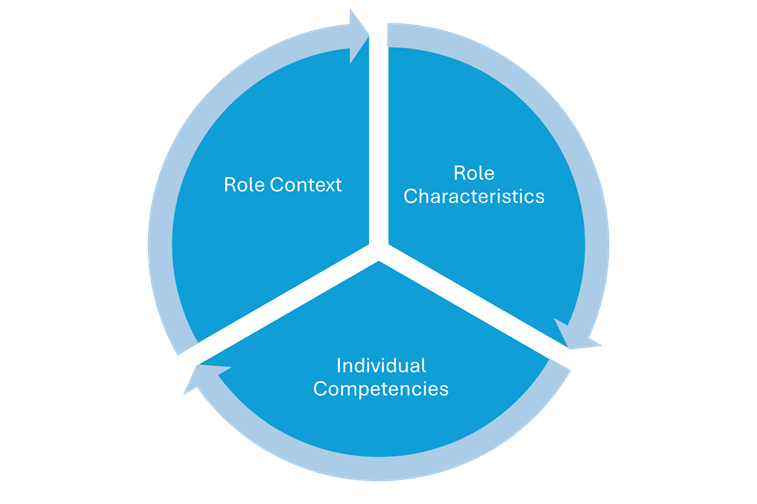
- Role Context: The seniority, influence, focus and degree of autonomy to be held by a person appointed a DE.
- Role Characteristics: The expected activities and contribution of a DE.
- Individual Competencies: The technical, organisational and behavioural skills required.
This document gives detailed examples of what can and should be included in each of these categories. In recognition of contextual differences that may exist between organisations using this definition, the document also outlines certain key principles that should transcend these differences and be applied across the board.
Introduction
The title ‘Distinguished Engineer’ has existed for over 40 years as a formal recognition of outstanding technical achievement in software engineering. In that time there has been little attempt to establish consistency across the organisations awarding the title. Consistency can apply to the role itself and what being a DE entails, or in the achievements and competencies required to be awarded the title, or in the process by which this decision is made.
A number of organisations with an interest in the space, within the Financial Services industry, have come together to address this, with the aim of establishing agreed standards and criteria that would need to be satisfied in order to confer the title ‘Distinguished Engineer’ on an individual working within this industry.
The membership of this group reflects common interests. Many of the awarding organisations are financial services organisations. Also involved are BCS, the Chartered Institute for IT, who are dedicated to the professionalisation of Technology-related careers. Davies Group, a consultancy operating in the financial services industry to improve the performance of technologists, is also represented.
This document sets out the definition that has been agreed by this collection of organisations. We do not profess ownership of this definition, and hope other organisations will sign-up to them and seek to improve them where possible. The standards were originally designed in 2017, with a consortium of banks, the BCS, British Telecom and IBM, and have been revisited in 2025, under the newly formed DE Special Interest Group created within the FINOS Community.
The benefits of having an agreed definition apply to organisations using the definition as well as the individuals awarded this status. A common definition gives the DE title currency across organisations, and establishes a sense of reassurance in what can be expected from a Distinguished Engineer (DE). They also allow DEs to plan their career development, giving a clear description of the competencies they are likely to need and the achievements to aim for if they are to become a DE. Organisations involved in the creation of career path frameworks and personal development programmes can incorporate these standards into their initiatives to ensure they achieve their goal. The standards also add much needed clarity on the role and responsibilities of a DE, avoiding confusion and enabling a consistent approach across awarding institutions.
At this stage, the awarding of the DE title is performed by the organisations themselves. It is hoped that over time, if this standard definition is more widely used, there could be a common accreditation process agreed, to ensure greater consistency and the portability of the title if individuals move between organisations.
Approach
We recognise that each awarding institution will have its own distinct approach and priorities, and that it will naturally want to impose these on any adopted framework. For example, an organisation may want to place significant emphasis on its core values when defining the role to be performed by a DE. Another may want to incorporate an existing competency framework when defining the competencies expected of a DE. Selection processes may differ in terms of whether a limit is placed on the number of people that can be awarded the title in any one year.
This kind of flexibility is vital if the definition is to be accepted and adopted. The definition has been developed in a way that allows that degree of flexibility while at the same time establishing increased commonality.
This has been achieved by specifying the principles to be observed, rather than the specific ways these principles should be applied. However, when defining the competencies of a DE the definition sets out three broad areas to be covered and suggests the specific traits, skills and competencies that could articulate each area. These are suggestions, not dictates, for awarding organisations to adopt, but we hope that many indeed do accept the definition largely wholesale.
Overview of the Definition
The definition covers the three main elements of a DE Function:
Figure 1: The three elements of a DE Function
Role Context
This refers to the positioning of the role a DE would occupy upon appointment. It should be significant in terms of scope and impact to require a DE to fulfil it. This ensures a person with the technical capability and track record expected of a DE has the opportunity to put their capability into practice and add significant value to the organisation.
Because of the variation in how roles are defined across organisations, it is not realistic to create a single role profile for Distinguished Engineers. This document lays out the core set of principles to be incorporated in each organisation-specific role definition. These principles define the common ground that constitutes the definition of the DE role comparable across industries.
Role Characteristics
This refers to the expected activities and contribution of a DE following their appointment. These may be similar to those the DE was already performing, though it is most likely to involve a greater contribution, commensurate with the role. Including these in the definition brings much needed clarity to what a DE is expected to do following appointment, and ensures this is broadly consistent across awarding organisations.
For a role to be considered at the DE level, the majority of these activities should be undertaken. However, given the diversity of organisations appointing DEs, discretion should be allowed as to which if any should be considered mandatory and which could be optional.
Individual Competencies
The Context and Characteristics of the DE role form the basis of the definition set out here. To meet these exacting standards, the individual DE must possess the necessary competencies. This forms the third element, though there is greater flexibility in how an awarding organisation specifies these. It is for each organisation to decide which specific competencies are expected and required, though clearly they should be sufficient to allow the DE to perform the role and make the contribution expected of them. They should also align well to the DE Characteristics. Each organisation must also decide whether these competencies are the ‘entry’ criteria, or whether there will be a period of time during which the DE will be helped to develop any competencies they lack to the required level.
Many organisations already possess detailed competency frameworks, and it is for each to decide how to incorporate the DE role into those. For example, should they specify the same competencies and raise the expected proficiency level to reflect the greater strengths expected of a DE? Or should additional competencies be added to reflect any new contributions to be made by DEs?
While it is for each awarding organisation to decide these questions, it is also important that the integrity of the DE role is maintained by applying universal standards that are higher than might be expected or required in less challenging or less senior technical roles. The definition outlined here gives the range of competencies that should be considered as well as the expected level of proficiency that might be required before an appointment can be made.
By applying this definition, an organisation can be confident that the role is appropriately significant in terms of strategic context, that there is clarity on the characteristics of that role in terms of what a DE is required to do, and that the person selected has the competence to fulfil these requirements.
Role Context
By applying this definition, an organisation can be confident that the role is appropriately significant in terms of strategic context, that there is clarity on the characteristics of that role in terms of what a DE is required to do, and that the person selected has the competence to fulfil these requirements.
Principle: The role to be performed by a DE, either before or after appointment, should be appropriately senior and significant in its impact to require a DE to perform it.
The definition of the role context should include the following four dimensions:
1. Seniority
- A senior level engineering role positioned at an Executive level, such as Director, Managing Director, or Senior Vice President in financial services organisations.
2. Influence
- Operate at an enterprise-wide level whose advice is actively sought by both internal and external peers and senior management.
- Influence and enable the organisation’s strategic goals through appropriate use of technology.
3. Focus
- Focus on the business value that the technology provides.
- Deliver outputs that make a significant contribution to the organisation’s strategic goals.
4. Autonomy
- Own the technology strategy for the business within which they operate.
- Act as a trusted advisor to the business.
- Has the independence and freedom to set direction without political or tactical influence from others.
In addition to the above, the organisation should clearly identify all roles that are deemed ‘DE grade’, irrespective of whether they are filled or not. There should also be a clear and transparent process to agree new roles that come within this category.
Role Characteristics
Principle: The characteristics of the role to be performed by Distinguished Engineers must include a broad range of contributions that reflects the value of the role to the organisation and the industry.
Organisations may choose to make some of these characteristics mandatory and some optional. The characteristics should include:
1. Contributing
- Contribute to the strategic goals of the organisation through the application of technology.
2. Solving Problems
- Solve problems through the application of technical knowledge and skill, determining when and how technology can solve business problems.
- Scope and create technical solutions that contribute to the business’s strategic goals.
3. Driving Change
- Enable the organisation to manage transformational business improvements through application of technical expertise and innovation in defining solutions.
- Drive successful change through innovative technological solutions.
4. Demonstrating Thought Leadership
- Using their engineering and industry expertise, develop organisational and individual capability.
- Have a positive impact on relevant technology communities.
5. Communicating
- Perform a vital communication role within the organisation on technology matters.
- Create strong relationships with the business and ensure the flow of information between technology and the business.
- Use communication as a tool for engagement, motivation and comprehension.
6. Connecting
- Develop and nurture an extensive internal and external network of technologists.
- Create a positive impact in the organisation and across the industry by sharing knowledge and expertise with others.
- Source knowledge and expertise for own initiatives and in supporting others to achieve their initiatives.
7. Developing Technical Talent
- Mentor and coach individuals and develop the community of technical talent.
- Drive creation and provide ongoing input and support for the delivery of technology talent programmes.
- Help create a pipeline of technical talent, identifying high potential individuals and helping to create mechanisms to recognise and develop the talent pipeline.
8. Sharing Knowledge
- Establish a broad reach across the organisation through knowledge sharing sessions and technology forums.
- Sponsor or lead communities of practice.
9. Accelerating the Adoption of Technology Best Practices
- Develop and roll out best practice in their domain of expertise or their specialism.
- Rescue, remediate or provide expertise on initiatives with significant technology challenges.
- Consider technology-related risks in designing best practice and common standards.
10. Representing the Organisation Externally
- Engage in external industry activities to inspire and drive engagement in innovation to advance technological capability across the industry and to help society in general through the use of technology.
- Promote the sharing of ideas through internal and external collaboration.
- Act as a ‘bridge’ between the organisation and regulators or industry bodies.
11. Sustaining the Value of Technology Communities
- Identify new areas of focus and activity for both internal and external technology communities.
- Contribute to the selection process for future Distinguished Engineer cohorts within the organisation.
- Help maintain the Distinguished Engineer standards across the industry.
12. Innovating
- Discover new technologies, insights and approaches through experimentation.
- Apply the learning from experimentation to the organisation and the industry.
- Balance appropriately the risks and rewards of innovation.
13. Complying with a Professional Code of Conduct
- Follow and abide by a code of conduct most relevant to the industry of the organisation.
- For Financial Services, this should be the Chartered Banker Code of Professional Conduct.
- A full description of the code of conduct can be found at the Chartered Banker Professional Standards Board (CB:PSB) website.
Individual Competencies
Principle: The competencies of a Distinguished Engineer should extend beyond technical excellence and include the ability to influence and collaborate.
Three categories of competence should be covered to reflect the ability of DEs to use their technical excellence to the benefit of the enterprise and the industry. The specific traits, skills and competencies within each category can reflect the organisation’s priorities and its existing competency frameworks.
The three categories are shown in Figure 2:
Figure 2:The Individual Competencies of a Distinguished Engineer
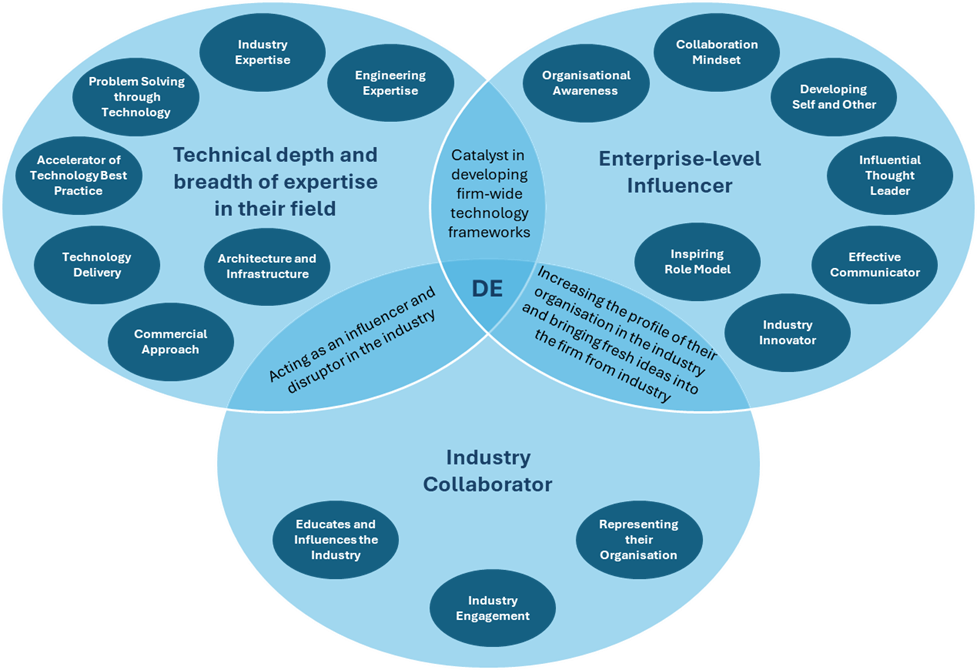
The following are suggested competencies within each category.
Technical depth and breadth of expertise in their field
1. Engineering Expertise
- As well as general breadth in knowledge across engineering and technology they have deep expertise in at least one field of engineering.
- They are widely known for this expertise across the organisation and also externally, are called upon to advise others in it, and use their expertise to increase the organisation’s capability in this area.
2.Industry Expertise
- As well as a general breadth in knowledge across financial services they have deep understanding in at least one area of the industry.
- They are able to use their industry expertise to build better solutions for their organisation and customers.
3. Problem Solving through Technology
- Understands and applies key change methodologies to plan and implement technological change.
- Able to consider the impact of technological change and the intended and non-intended consequences when planning change.
- Applies analytical and problem-solving skills to resolve complex problems.
- Considers operating patterns and resilience in designing solutions.
4. Accelerator of Technology Best Practices
- Is able to reduce the time taken to introduce technology best practices through identifying and influencing the points of maximum leverage, pre-emptively addressing potential obstacles and building broad alliances that transcend narrow interests.
- Focuses best practice on simplification, safety, effectiveness and commercial aspects, looking to incorporate concepts such as re-use, open source, cyber security, automation, resilience, etc.
5. Technology Delivery
- Able to shape the processes and organisational operating models to ensure the effective development, testing, release and support of applications in a production environment.
- Proactively improves the delivery of technology and ensures the organisation remains competitive with best-in-class technology organisations, through increasing collaboration across teams, shift left practices, automation, etc.
- Is able to work effectively with the broader organisation and different stakeholders to meet delivery goals.
6. Commercial Approach
- Understands how and why products and services in their business are offered and consumed and the value they deliver.
- Understands the commercial context for selecting solutions and running technology functions.
- Is able to use metrics to evidence value and influence management buy-in.
7. Architecture and Infrastructure
- Understands underlying infrastructural concepts such as networking, databases, compute, etc in order to better design solutions.
- Engages, influences and drives better architectural standards and plans.
Enterprise-level influencer
8. Organisational Awareness
- Understands and is able to work within formal and informal organisational processes to bring about change and extend their influence.
- Politically astute, able to work effectively with different stakeholders to manage sensitivities and ensure broad alignment across different constituencies.
9. Collaboration Mind-set
- Thinks and behaves in ways that are consistent with win-win outcomes.
- Collaborates effectively with related technical professionals.
- Combines assertiveness with the ability to cooperate to achieve the best outcomes for all parties and a stronger solution.
10. Developing Self and Others
- Comprehends the difference between coaching and mentoring and knows when and how to apply them.
- Applies both approaches effectively to enhance organisational technological capability, through developing self and others.
11. Influential Thought Leader
- Influences the way the organisation and its individuals think about technology.
- Able to innovate to create new ways of working and more effective solutions and drive these forward to the point of becoming received wisdoms and norms.
12. Effective communicator
- Has the ability to communicate complex technology with clarity and simplicity to a variety of audiences.
- Uses communication to generate awareness, understanding, engagement and commitment.
13. Industry Innovator
- Draws on analytical capabilities to support and deliver innovation within the organisation.
- Brings these innovations into the industry, shaping the way things are done across the industry and across other technology organisations.
14. Inspiring Role Model
- Represents the pinnacle of an engineering career path.
- Is seen as a role model and their position is aspirational to others.
- Role model across the industry and DE community(s).
Industry collaborator
15. Educates and Influences the Industry
- Applies their technical knowledge to shape thinking across theirs and broader industries.
- Has the skills needed to do this in a way that is accepted and appreciated by those the Distinguished Engineer seeks to educate and influence.
16. Industry Engagement
- Member of industry forums, and contributes to open source.
- Remains abreast of technological developments, engaging/contributing to research.
- May publish patents on behalf of their organisation.
17. Representing their Organisation
- Attends conferences and broader industry events, either as a speaker or a panel member, representing their organisation.
- Represents their organisation from a technology perspective with regulators and standards bodies.
Conclusion
This document seeks to clarify and promote the role of Distinguished Engineer in financial services. There is no reason why the definition laid out here may not be applied to software engineering roles in other industries. However, given the foothold already established in a number of banks over many years, it was decided to begin the process here and hope that it will be adopted by others within financial services and then potentially outside the industry.
Although generated by people based in Europe, the definition is intended for global use and adoption. The approach adopted was to take advantage of what already existed (in this case a group of people meeting regularly to pursue this goal and a previously defined standard) in the hope that others outside this initial group will make use of the work they have generated.
This kind of flexibility is vital if the definition is to be accepted and adopted. The definition has been developed in a way that allows that degree of flexibility while at the same time establishing increased commonality.